
My partner and I have recently learnt more about parenting than many people ever have, especially for two people without children. This comes from the usual places of friends having children, parents urging us to have children and the inevitable, “Do we want children?” discussions.
With what felt to be a constant stream of advice from everyone around it, people seemed to be either very for parenting “It makes life meaningful!” or very against parenting “Worst mistake I’ve ever made.” They also range from being very parenting-focused “You dedicate your life to your children” to very laid back “Well, as long as they’re alive at the end of the day.”
This time in life is very natural to be having this discussion. Over 30, living together for a while, pretty sure we’re going to be together for the long haul. We discussed our hopes (angel children) and our fears (losing who we are) and our biggest fear, which was losing us.
Alongside family and friends, I’ve also learnt a lot about parenting from my recent training in the Bringing Baby Home course. Thinking I was going to learn all the answers and put my fears to rest, I was terrified when I found that studies actually show for two thirds of couples these fears are true! Their relationship satisfaction does drop significantly.
You can imagine the intensity of my concentration as the class began, itching to explore all the ways for a relationship to thrive after having children, as well as many parenting tips, tricks and facts to help a baby thrive!
Today I want to share with you just a few of the things I learnt along the way…
Each of us behaves in relationships in one of three distinct ways:
- Anxious people tend to worry about their partner’s ability to love them back.
- Avoidant people equate intimacy with a loss of independence and constantly try to minimize closeness.
- Secure people feel comfortable with intimacy and are usually warm and loving.
When partners are emotionally available and are able to discuss both the good and bad things in life, the couple’s attachment bond creates a safe haven that makes both partners feel safe, calm, and emotionally connected and this can then transfer to a child. This loving relationship gives us a secure base to expand our sense of self and increase our confidence.
Therefore, the best thing we can do for our children is to make sure we are continuing to work on our relationship.
Gottman identifies 4 major reasons relationships experience a decline after having a child. These include:
- The Profound Philosophical Shift
- The Distinct Relationship Changes
- Some Withdrawal
- The Physical and Psychological changes from birth and beyond
Through knowing the reasons behind a decline in relationship satisfaction, and from his prior research in what makes relationships thrive, Gottman was able to create this workshop using the same Sound Relationship House Theory – but now including kids!
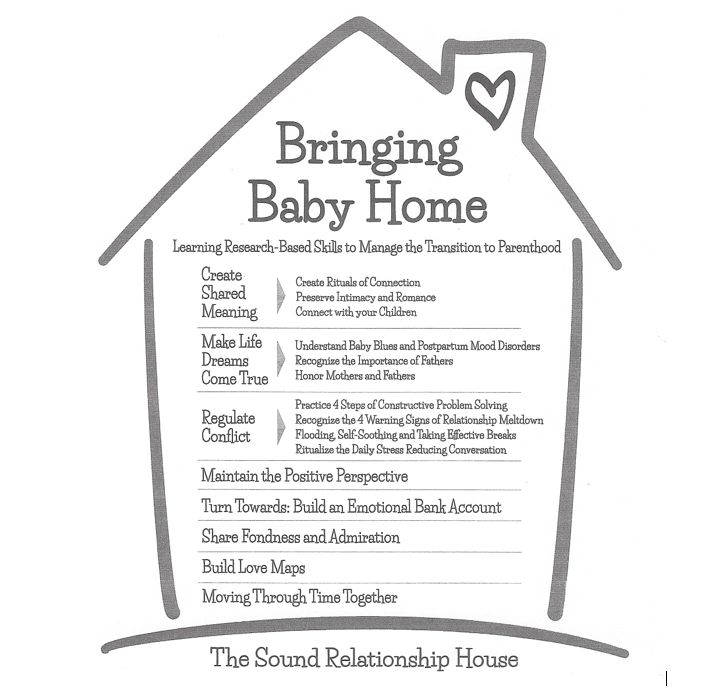
This is one of the parts I really lapped up. As I knew a lot of the relationship side of things from previous couples counselling training, I was eager to get to the ‘how to make angelic kids’ part of the day. No surprise to any parents out there…there is no one golden rule, and no such thing as an angelic child.
As it turns out, the thing about teaching a child good habits and secure attachment is that it starts from the very beginning.
As parents, we create a secure attachment through:
- Learning about Attachment itself
- Learning about Temperament itself and how it makes babies, even in the same environment, act so differently
- Learn about Self Regulation both for ourselves and the child
One of the craziest things I learnt during the course was the importance of touch, and the fact that a baby will literally mimic the physiology of its mother, especially when being touched.
This is why we have ‘skin to skin’ contact with a newborn. They have just gone from being somewhere warm, dark and safe, to … well, the world, and we each know how stimulating that can be! To give them a sense of calm, we ourselves stay calm, then the baby’s physiology will work to match that state. If we stay stressed and anxious, unfortunately the baby copies that too.
Becoming a Zen master as a new mother does not sound easy to me. Luckily there are also other ways to help our newborns, our bubs and even our terrifying toddlers learn to self regulate, remain calm and resilient and develop secure attachment styles.
I’m still no expert, but I learnt a lot in this course and have now been taught how to teach it. I can’t wait to bring it to the Illawarra and give away all its other secrets, it has certainly helped me already (and I don’t even have kids yet!).
Stay tuned for more information about our first Bringing Baby Home Workshop.
Cathy